
Introduction
The dominant narrative surrounding AI infrastructure assumes that semiconductor manufacturing capacity is the primary bottleneck. However, by 2025, multiple EPC contractors reported that electrical equipment availability increasingly determines data center construction sequencing.
AI deployment is no longer constrained only by silicon fabrication, but by the physical and temporal limitations of electrical infrastructure. Grid interconnection queues, transformer shortages, gas turbine lead times, transmission bottlenecks, cooling systems, and utility-scale power delivery timelines are becoming the principal constraints on deployable AI capacity.
This divergence is measurable. A frontier-scale AI campus now commonly requests between 300 MW and 1 GW of continuous power capacity, while conventional hyperscale campuses from the previous decade often operated below 100 MW. A 1 GW AI campus consumes power comparable to a large nuclear reactor or hundreds of thousands of households.
In a single year, data centers are expected to require approximately 74 GW of three-phase transformer capacity, roughly equivalent to the annual replacement rate of the existing U.S. power grid.
GPU procurement cycles remain relatively short, with delivery times often ranging between 6 and 18 months. The electrical infrastructure required to energize those GPUs operates on entirely different timelines. The U.S. Department of Energy estimated in 2025 that large AI data centers may require 5–7 years from initial utility engagement to full energization when new transmission or substations are required.
This mismatch has reshaped site selection strategy. Hyperscalers increasingly explored colocating AI campuses near nuclear plants, hydroelectric corridors, or stranded industrial power assets because transmission proximity became more valuable than metropolitan adjacency [2].
The U.S. electrical supply chain also carries significant geopolitical exposure. The country imports 70%–90% of the value of core AI grid infrastructure. Lithium-ion backup systems remain particularly concentrated: China controls approximately 59% of direct U.S. battery imports and 99% of upstream LFP cathode production.
Attempts to bypass utility constraints through behind-the-meter generation do not eliminate Layer Zero bottlenecks. On-site power generation still requires transformers, switchgear, turbines, cooling systems, fuel infrastructure, synchronization equipment, and emissions permitting, all of which remain supply constrained.
As operators moved toward behind-the-meter generation, procurement lead times for industrial gas generators and large chillers extended to roughly 24–40+ weeks, while equipment costs rose approximately 40% above baseline levels. Long-lead equipment constraints and utility lockouts also contributed to a sharp increase in project cancellations, which rose from 6 in 2024 to 25 in 2025.
Transformers
Transformers have become one of the clearest examples of Layer Zero scarcity.
The North American Electric Reliability Corporation reported transformer lead times exceeding 120 weeks in 2024, while some large power transformers reached as long as 210 weeks. The IEA’s 2025 Building the Future Transmission Grid report found that transformer lead times have roughly doubled since 2021 across major markets, with some high-voltage units reaching 2.6× pre-pandemic prices in real terms.
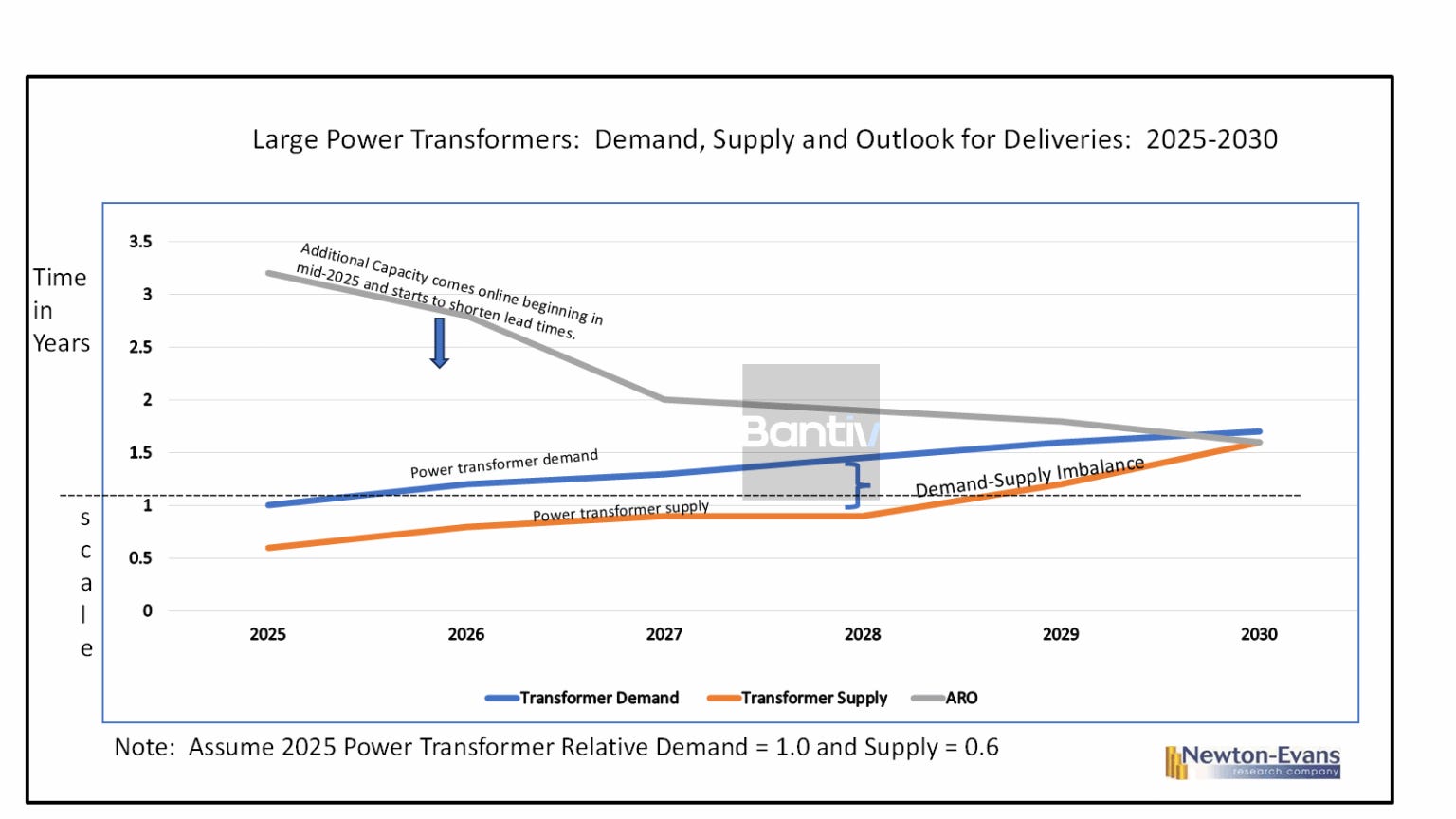
Source: Newton-Evans
Wood Mackenzie industry data showed transformer prices rising approximately 77% since 2019 [11] .
By Q2 2025:
- Standard power transformers averaged roughly 128 weeks for delivery [5].
- Generator Step-Up (GSU) transformers averaged approximately 144 weeks.
- Specialized large-scale configurations extended toward four years.
- Extra-high-voltage transformers in the 345–765 kV range carried procurement windows of 36–48 months.
- Megaprojects exceeding 100 MVA faced lead times of 48–60 months.
Transformer manufacturing scales far more slowly than semiconductor fabrication because production depends on grain-oriented electrical steel, heavy forging capability, skilled labor, and multi-year factory commissioning cycles.
The U.S. imports nearly 90% of large power transformers, while manufacturing remains geographically concentrated in China, South Korea, Austria, Germany, and Japan. This concentration creates additional geopolitical exposure for North American AI deployment.
Demand growth is also compressing supply. Industrial padmount transformer demand is forecast to increase from roughly 1,573 units annually to approximately 9,395 units by 2030, consuming large portions of global specialty component capacity.
The practical consequence is straightforward: facilities breaking ground today often cannot sequence electrical energization on timelines compatible with modern GPU deployment cycles. Equipment availability, not capital allocation, has become the gating constraint.
Copper markets reflect similar pressure. Electrification demand from AI infrastructure, EV charging, renewable integration, and industrial expansion has contributed to multi-year highs in copper pricing.
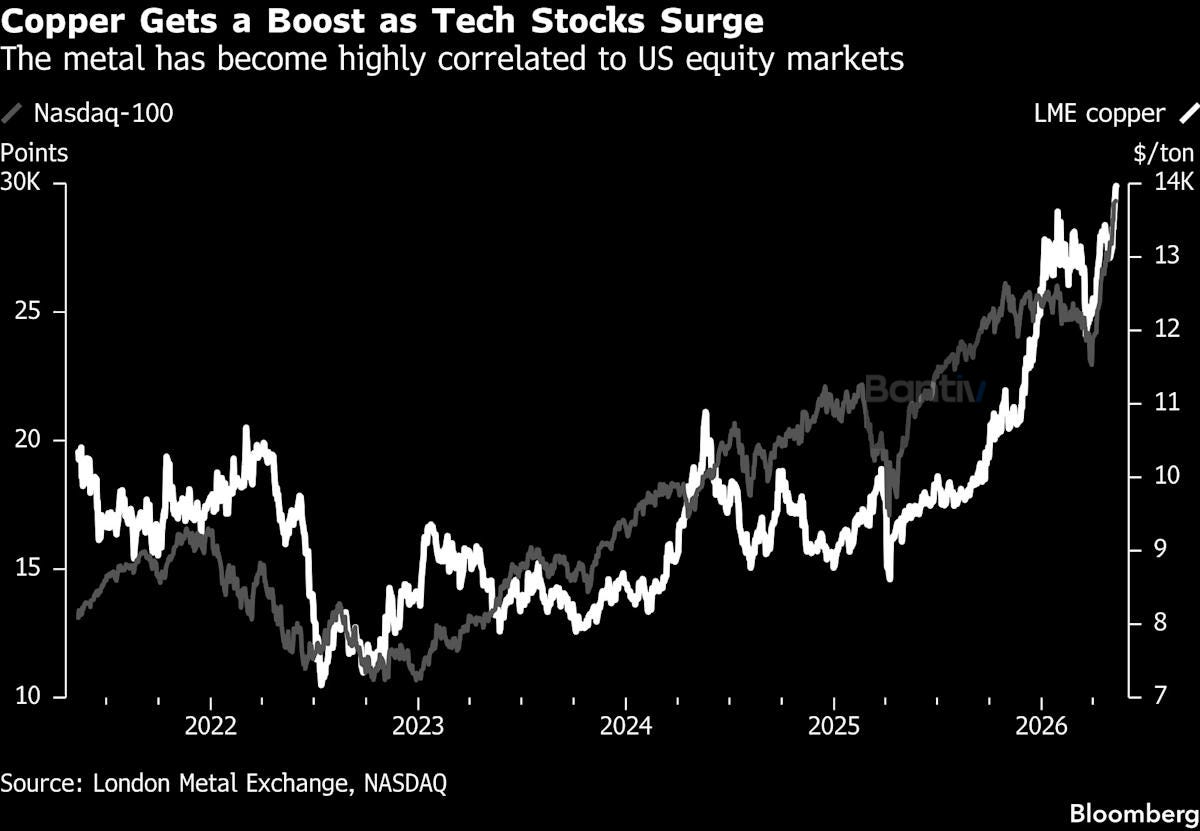
Source: Yahoo
Switchgear and Electrical Distribution
Switchgear procurement has also deteriorated significantly.
Utilities and data center developers reported medium- and high-voltage switchgear lead times extending far beyond historical norms, in many cases reaching roughly double pre-pandemic baselines.
The same manufacturing ecosystem now simultaneously serves:
- Utilities
- Renewable integration projects
- Semiconductor fabs
- EV charging infrastructure
- Industrial electrification
- Hyperscale AI campuses
Hitachi Energy acknowledged in 2023 investor materials that order backlogs had reached levels not seen since the industrial buildout cycle of the 1970s.
AI infrastructure is therefore competing against multiple electrification megatrends for identical electrical supply chains.
Gas Turbines and On-Site Generation
Gas turbine deployment reflects the same mismatch between AI demand growth and industrial manufacturing capacity.
Multiple hyperscalers and developers began exploring dedicated gas generation to bypass constrained utility grids. However, turbine manufacturing itself has become supply constrained.
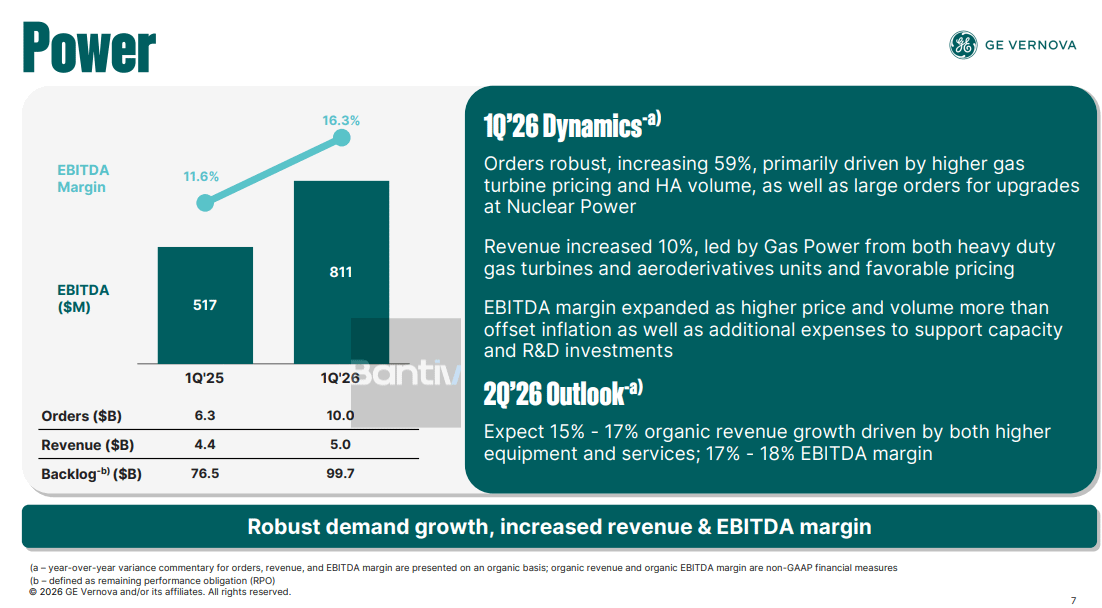
Source: GE
By 2025–2026, large-frame gas turbine lead times in the U.S. expanded toward roughly 5–7 years due to simultaneous demand from [6] :
- AI data centers
- Industrial reshoring
- Grid electrification
Turbine economics further concentrate value within constrained components. Turbine blades account for roughly 35% of total turbine value, while blade gross margins have remained above 40% for extended periods. Another key material is yttrium, used in thermal barrier coatings [7]
Major suppliers include GE Vernova, Rolls-Royce, RTX, and Siemens Energy.
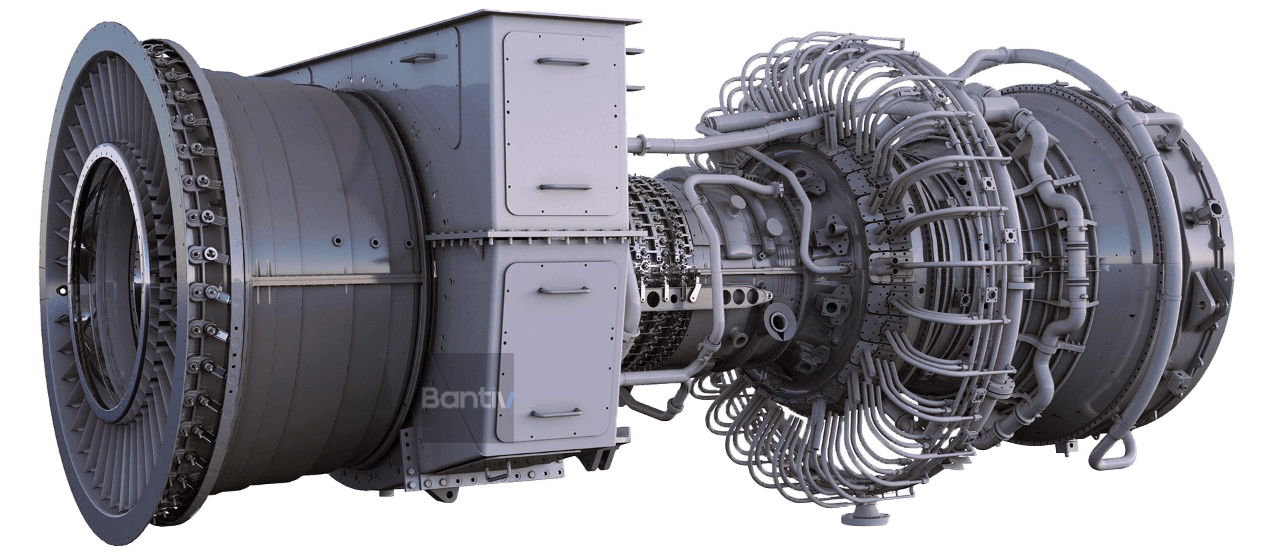
Source: GE LM6000 GE Vernova
Natural gas increasingly became attractive because pipeline connections can often be completed faster than utility grid upgrades. A behind-the-meter gas-fired plant connected directly to a major pipeline may be deployed in roughly 18–24 months, compared with 5–7 years for grid expansion timelines.
This shift is driving large firm gas supply agreements, including TerraVolt Infrastructure’s 55,000 MMBTU/day agreement supporting a 240 MW AI campus in Idaho [8].
Despite the growing interest in gas, diesel generators still represented approximately 72.6% of the market in 2025, while gas generation accounted for roughly 20% but remained the fastest-growing segment.
Power strategies increasingly split into three deployment horizons:
- Immediate: diesel generators
- Medium-term: gas turbines and aeroderivatives
- Long-term: nuclear and grid expansion
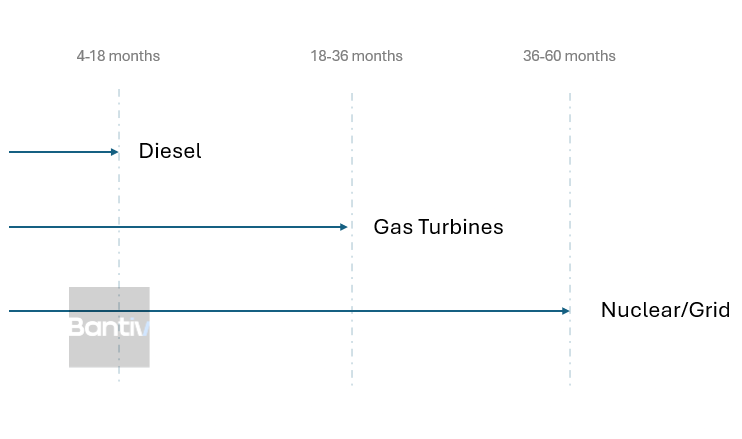
Nuclear generation does not eliminate backup infrastructure requirements. Data centers colocated near nuclear assets still require extensive emergency backup systems.
An Amazon facility in Manassas, Virginia, for example, reportedly operates 93 generators rated at 2.5 MW each.
Cooling Infrastructure
Cooling infrastructure is emerging as a parallel bottleneck as rack densities exceed the practical limits of traditional air-cooled architectures [9] .
Frontier AI campuses now require both scalable electrical capacity and scalable thermal rejection capacity. In water-constrained regions, cooling infrastructure itself becomes a deployment constraint independent of compute availability.
Thermal management increasingly affects site geography, particularly as liquid cooling adoption accelerates.
Batteries and UPS Systems
Battery supply chains have also tightened materially.
Although Valve-Regulated Lead-Acid (VRLA) systems still account for roughly 58% of legacy backup deployments, hyperscalers increasingly standardized on lithium-ion systems, primarily LFP chemistries, due to higher energy density [10].
As a result, data centers are competing directly against utility-scale BESS deployments and EV manufacturing. Additionally, large DC-link film capacitors and screw-terminal electrolytic capacitors used inside UPS rectifier and inverter stages remain among the most constrained passive components, with 20–52+ week lead times. Key manufacturers and their public stock tickers include TDK Corp $TYO:6762, Vishay VSH -3.74%↓ , and Nichicon $TYO: 6996
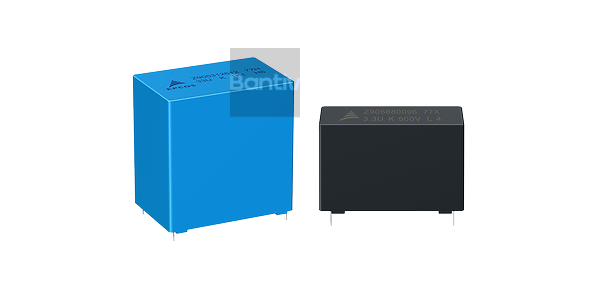
Source: TKD
UPS systems face similar constraints. Lead times for insulated-gate bipolar transistors (IGBTs) and heavy film capacitors expanded toward approximately 52 weeks as semiconductor fabs prioritized automotive inverter demand.
Large modular double-conversion UPS systems reached lead times of roughly 38–50 weeks, requiring procurement to begin near the earliest stages of site construction and putting the warranties at risk considering this time is usually 12 months after purchase.
We conducted in april 2026 a consult with differente UPS providers who also reported UPS lead times commonly ranging between 40 and 45 weeks in Vertiv and 38-43 for APC depending on load.
Mega-scale modular double-conversion UPS systems for hyperscale AI campuses are now commonly quoted at 38–50 week lead times.
Fire Detection and Fire Protection
Conventional smoke detection systems are ineffective in high-density AI halls due to extreme airflow and liquid cooling environments[12].
Operators increasingly require Aspirating Smoke Detection (ASD/VESDA) systems capable of continuous air sampling. Demand growth pushed lead times for custom multi-criteria laser sensing systems toward 26–40 weeks.
Fire suppression systems face similar pressure.
High-voltage AI environments rely primarily on total flooding systems using clean chemical agents or inert gases, including FK 5-1-12, Novec 1230, and IG-541 systems.
Growing deployment volumes, combined with tightening environmental regulation around halocarbon production, pushed lead times for specialized suppression equipment toward approximately 30–48 weeks.
Conclusion
The scarcity inversion is measurable.
Frontier GPUs depreciate on technology cycles measured in 18–36 months, while transmission systems, substations, and grid infrastructure operate on planning horizons measured in decades.
AI infrastructure demand is colliding with simultaneous electrification megatrends, including EV charging, semiconductor fabs, renewable integration, industrial electrification, and hydrogen projects. All compete for the same transformer, switchgear, turbine, and power equipment supply chains.
The primary constraint on AI deployment is no longer semiconductor fabrication alone. Increasingly, it is the procurement and energization of Layer Zero infrastructure.
References
[1] Reuters, “Rush for US gas plants drives up costs, lead times,” Jul. 2025.
[2] American Public Power Association, “Study Details How Data Centers are Building Their Own Power Plants,” Feb. 2026.
[3] C. A. E. LED, “Supply Chain Stability & Lead Times in Data Centers: 2025 Benchmark Guide for Critical Equipment,” 2025.
[4] Power Engineering, “Data center onsite power deployments to increase, according to new survey,” Jun. 2025.
[5] W. Garrett, “Power Transformer Lead Times Hit 128 Weeks in 2026,” IndustrialSage Headlines
[6] Financial Times, “Data centres turn to aircraft engines to avoid grid connection delays,” 2025.
[7] Reuters, “GE Vernova working with US government to boost stocks of rare earth yttrium,” Dec. 2025.
[8] Pipeline & Gas Journal, “TerraVolt Taps Northwest Pipeline for Idaho AI Data Center Project,”
[9] Bantiv, “The thermal Wall: The Physics, Economics, and Supply Chain of the Liquid Cooling Transition,”
[10] Intel Market Research (IMR), “Battery for UPS Market Outlook 2026-2034,” Report No. IMR-27278, Jan. 30, 2026
[11] Wood Mackenzie, “Data center demand drives US electrical equipment market to $65B, reshaping industry dynamics,” News Release, Apr. 28, 2026
[12] A. Tan, “AI-driven Data Center: Fire Protection and Suppression Technologies to Strengthen Critical Infrastructure Security,” Siemens Blog, Mar. 13, 2026