

Introduction
The data center industry has spent three decades optimizing airflow. The engineering community was resourceful at improving efficiency from a fundamentally limited thermodynamic medium: Air. Those days are over.
NVIDIA announced in 2025 the GB200 NVL72, a 72-GPU rack system that dissipates 120–132 kW of heat in the footprint of a rack. Additionally, According to Mc Kinsey, in 2014, a 30-megawatt (MW) center was considered large. Today, a 200-MW facility is considered normal. That was not a problem air cooling was designed to solve. Luckily, as the second law of thermodynamics has showed us, water has a volumetric heat capacity roughly 3,500 times greater than air. The thermal inflection then reshaped every layer of the data center value chain.
This report maps that transition in full. We analyze the physical limits of air cooling, the economics of the switch, the full taxonomy of liquid cooling architectures, the next generation of disruptive technologies, the picks-and-shovels supply chain, and the equity implications of the liquid cooling market that according to estimates is expected to grow 33% every year through 2032.
I. The Thermal Inflection: Why Air is No Longer Sufficient
The Physics of the Problem
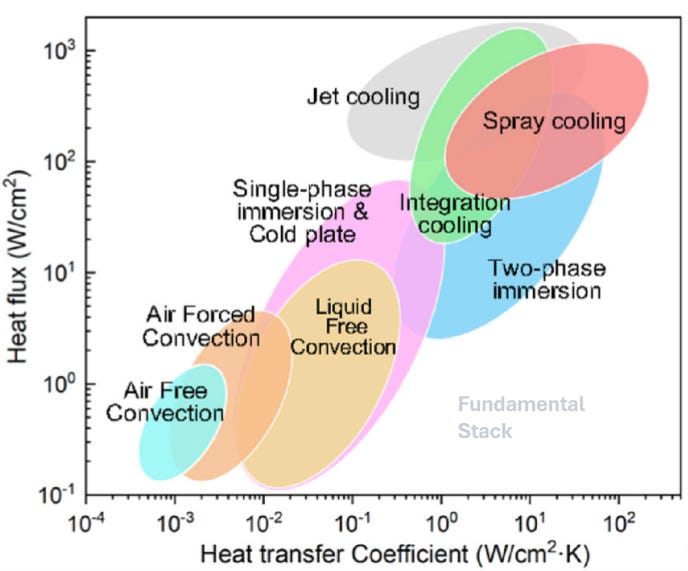
The fundamental constraint in data center cooling is the heat transfer coefficient, which measures how quickly a medium can pull heat away from a surface. Air-to-surface convection has 25–250 W/m²·K depending on flow velocity, on the other hand, water-to-surface convection achieves 3,000–15,000 W/m²·K , a 60X improvement in efficiency. By using optimized cold plates that bring liquid into direct contact with the chip package, these rates could increase up to 50,000 W/m²·K.
The physics of heat transfer of water could solve cooling at high power densities that for air is virtually impossible without leading hot spots, chips throttling or equipment failures.
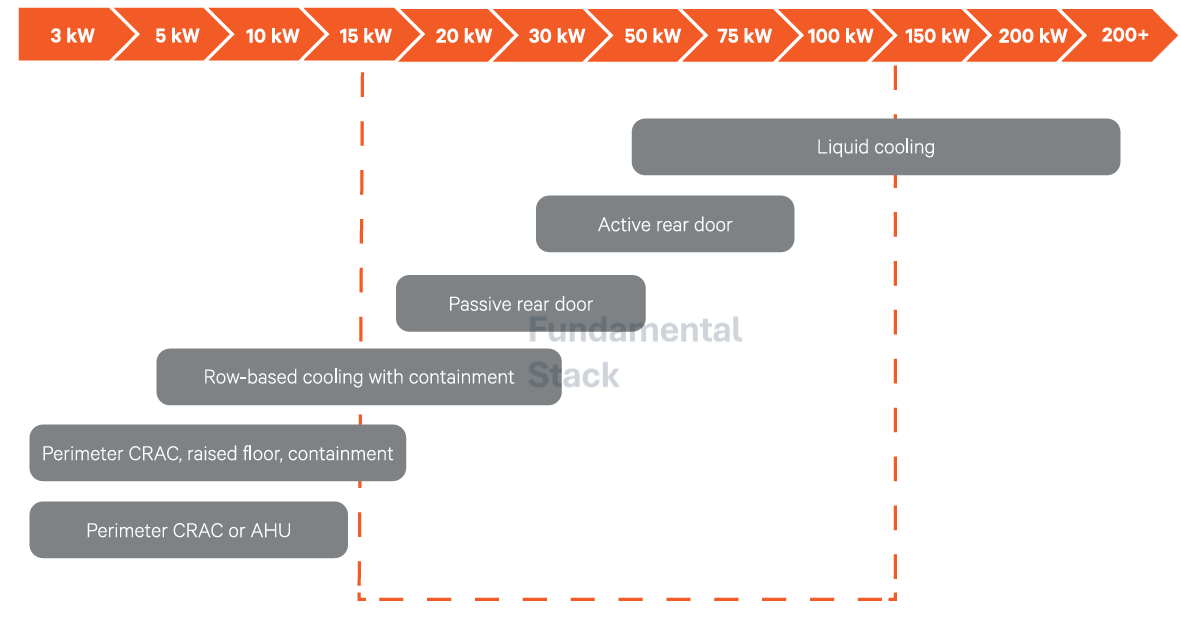
Average rack power density of new facilities across deployed data centers doubled in two years going from 8 kW in 2022 to 17 kW in 2024 refering to AI data center, this according to a McKinsey report and is projected to reach 30 kW by 2027 on average.
Another data point is Uptime Intelligence that trainig large models that lead to jump rack loads, current generation systems can surpass 40 kW, while 2025 generation will exceed 100 kW. By contrast, AI trainig as setup are smaller lowering but still above industry average densities 10kW.
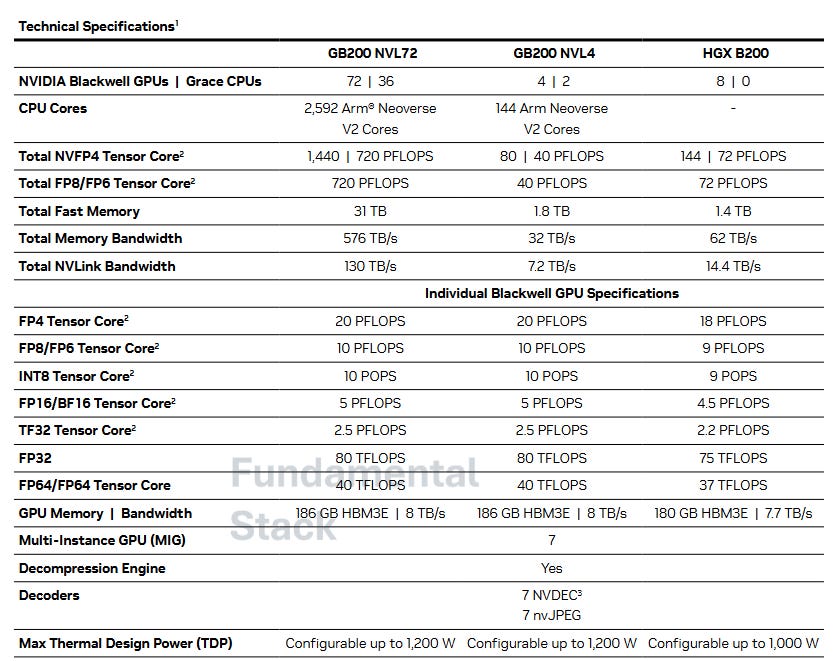
The driving force for this is the computing power required for AI workloads. Chip models for instance, tend to increase TDP per GPU(Thermal Design Power) over time and new designs tend to increase heating intead of reducing it. This trend repeats for NVIDIA, AMD and other chip designers. For NVIDIA’, for instance : Hopper generation H100 NLV released in 2023, typically operates at 350W, while their GB200 GPU, have 1,200W TDP per GPU, a 4X TDP per GPU ingrease in just two years. The TDP’s scenario for case of Google’s TPU is estimated between 250W and 300W.
Density and latency are currently a “trade-off.” The increase in density resides in the ease of the remote latency of GPUs and compute nodes which depends on advances of networking. Further advances in this area could alleviate the increase in energy density and therefore, the capex in implementation in liquid cooling.
The operational challenge
ASHRAE TC 9.9 introduced the H1 equipment class to categorize the latest high-power accelerators and chips. While older legacy equipment (Class A) could operate with inlet air up to 27°C, these new H1 systems require a much stricter environment of 18°C–22°C, with a hard limit of just 25°C.
This narrow temperature window creates a massive efficiency problem. When the gap between the room air and the chip’s limit shrinks, the air loses its ability to effectively extract heat. To compensate, data centers must run larger cooling systems just to maintain that temperature window, supporting that at certain power density levels, air cooling is not merely inefficient but unfeasible.
To make it even more challenging, the thermal ride-through, the time between a pump failure and the processors overheating, can be as short as 23 seconds. This incredibly tight window leaves almost no time for backup systems to be triggered, putting the servers at immediate risk of throttling or permanent damage.
Additionally, according to the white paper developed by Ashrae says that high-density air cooling is hitting a biological wall: the heat exhausted into the “Hot Aisle” is becoming hazardous to human operators. Under OSHA’s heat-stress standards, even simpler maintenance tasks requires a 30-minute break every hour once rack inlet temperatures hit 27°C. If, hipotetically, temperatures reach the 32°C! allowable limit, the hot aisle becomes so intense that no work can be safely performed without the use of specialized cooling.
Liquid cooling adoption
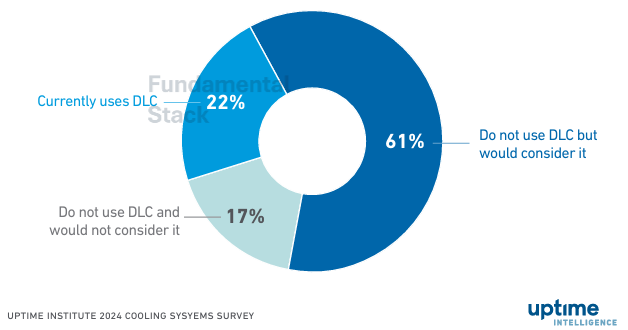
There isn’t clear concensus about current adoption lo liquid cooling.
According to the AFCOM State of the Data Center Report 2025, 19% of respondents (up from 17% last year) have implemented liquid cooling in their facilities.
A 2025 survey prepared by Uptime Institute, shows 22% use of DLC.
On the other hand, a nVent reports an estimate that only 5% of data centers are currently liquid cooled, but this is rapidly growing. The same company reports 20% growth for 2025 in their infastructure vertical which includes data center cooling solutions.
The DOE estimates that cooling already accounts for up to 40% of data center energy consumption. And we’re seeing rack densities growing nonlinearly, and maintaining safe inlet temperatures after +30 kW rack using air requires airflow velocities that are incompatible with stable operations.
But more than obsess with quantitative data, we must consider that no single product has accelerated the liquid cooling transition than the NVIDIA GB200 NVL72. This rack-scale system delivers 1.4 exaFLOPS of FP4 AI compute and consumes 132 kW per rack at full utilization, of which 115 kW is removed by direct-to-chip liquid cooling and 17 kW is handled by residual air cooling for peripheral components.
To contextualize the increase, the industry average rack density as of the Uptime Institute 2024 Global Data Center Survey was below 9 kW. The NVL72 is 16x that average.

The liquid cooling requirement extends beyond heat load: physics of copper interconnect reach. With 72 GPUs in a single NVLink domain communicating at 130 TB/s aggregate bandwidth, eliminating air-cooled heatsinks allows the physical proximity between accelerators required for copper passive cable backplane interconnect. Were these GPUs air-cooled, the heatsink clearance envelopes would prevent the rack-scale NVLink topology. Therefore, NVL72 architecture makes liquid cooling non-optional.
The Capital Arbitrage: Liquid Cooling’s breakeven
Historically, the case against liquid cooling was cost. The “CapEx premium” often made air cooling the default choice for operators. But as power densities skyrocket, this trade-off is being inverted.
While optimized air-cooled designs fight to maintain a PUE of 1.2–1.3, liquid cooling systems consistently achieve 1.05–1.15. In an environment where cooling represents nearly 40% of the facility’s total load, this PUE gap isn’t just a technical metric; it’s a massive OpEx arbitrage opportunity.
Additionally, there are case studies that compares liquid cooling and found that liquid cooling systems are more economical for servers with power rconsumption greater than 5kW in both single of two-phase liquid cooling when compared with air cooling.
Another adoption case comes from a study where two-phase immersion cooling using Novec 649 is more efficient than air. For instance, cooling systems Coefficient of Performance (COP) was 6.7 ∼ 7.7 times that of the traditional air cooling system in four typical cities. Moreover, the estimated cost of immersion cooling system is much lower than that of traditional air cooling system.
Mapping the Inflection Point
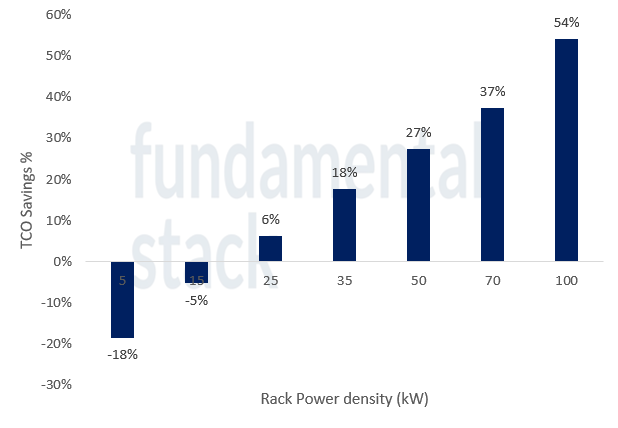
To quantify this shift, I developed a TCO sensitivity model comparing air-cooled designs against direct-to-chip (DTC) liquid architectures over a 10-year horizon and under certain assumptions.
The model utilizes a tiered CapEx structure to account for the “Air Wall”, the exponential increase in costs as air-handling hits physical limits. This includes the penalties of aisle containment and “stranded capacity,” where rack space is left empty simply to allow air to flow. In contrast, liquid cooling scales linearly.
As shown in the analysis, the transition to liquid cooling ceases to be a technical preference and becomes attractive after 30-35kW threshold.
By the time we reach the +100kW AI-standard rack, the TCO advantage of liquid cooling reaches a staggering 54%. This is driven savings on building footprint, raised floors, and massive CRAC units more than offset the cost of the liquid infrastructure coupled with an aggressive reduction in long-term energy intensity.
It is important to note that cost is not the only factor in implementation, even though it is a significant one.
II. Technical Architecture and Efficiency Gains
The Full Taxonomy of Liquid Cooling
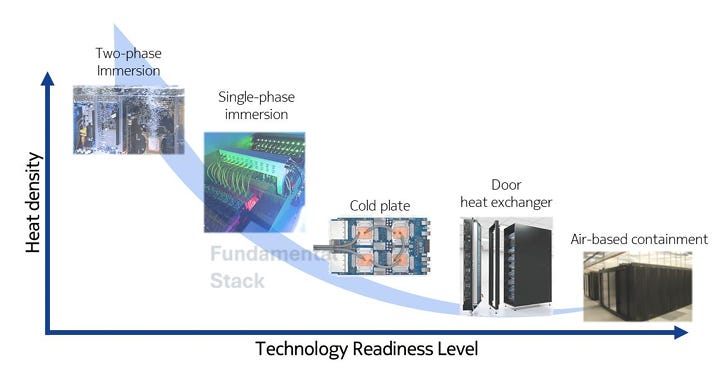
The cooling solution is not a linear hierarchy. It is a set of trade-offs between thermal performance, integration complexity, capital cost, and operational risk. Each technology has a distinct profile that solves and depend on standarization, heat density , TCO, Capex and other variables.
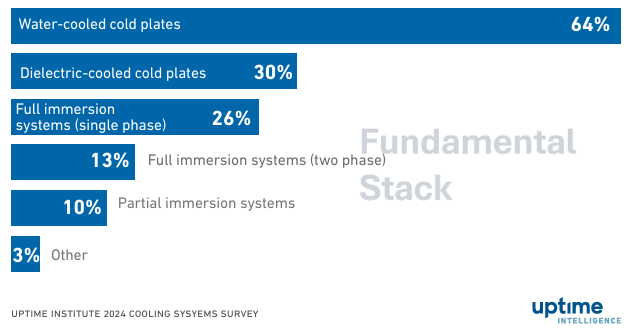
According to Uptime Intelligence, immersion cooling stills like the less frequently adopte liquid cooling method in comparisong to others .
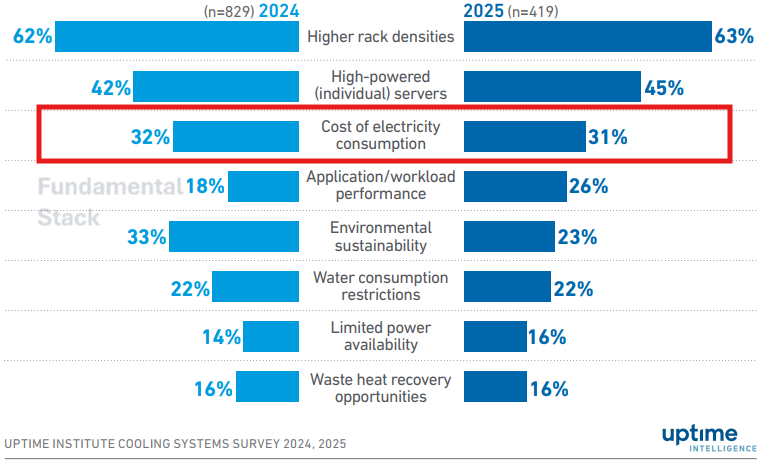
Additionally, as the electricuty consumption of data center still accounts for more than 35-40% of total electricity consumption, the adoption of cooling methods stays relevant and as we’ll see later, relies on economical factors among other things. This is one important factor that will drive adoption.
Rear-Door Heat Exchangers (RDHx)
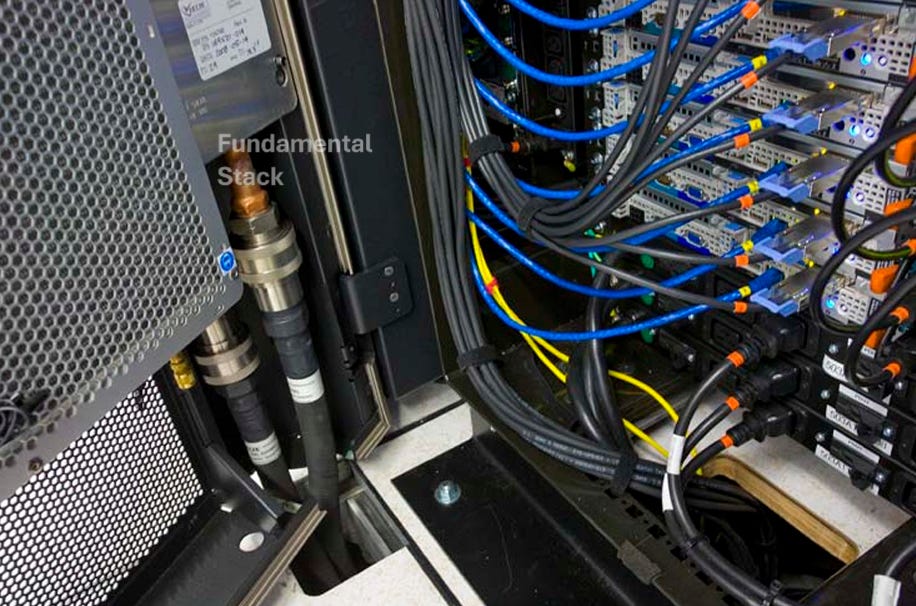
A typical rear door cooling consist in a door with a depth of 4 to 12 in (depending on rack height), atached to the back of each rack that removes heat and derives to a heat transfer. RDHx could work with CRACS or perimeter cooling to keep room conditions.
The RDHx is the lowest-friction entry point into liquid cooling, a retrofit friendly. RDHx is compatible with unmodified air-cooled servers and does not require changes to server OEM designs. This makes it the preferred transition technology for data centers with legacy infrastructure. The limitation at rack loads above 60–70 kW, the air-to-liquid heat exchange surface area of rear-door systems becomes insufficient, and the solution requires a transition to direct-to-chip architectures.
Direct-to-Chip / Cold Plate (DTC)
Direct-to-chip cooling, currently the dominant architecture for hyperscale AI clusters like the NVIDIA NVL72, delivers liquid coolant through cold plates bolted directly to CPU and GPU chip packages to remove 80–95% of heat at the source with minimal thermal resistance.
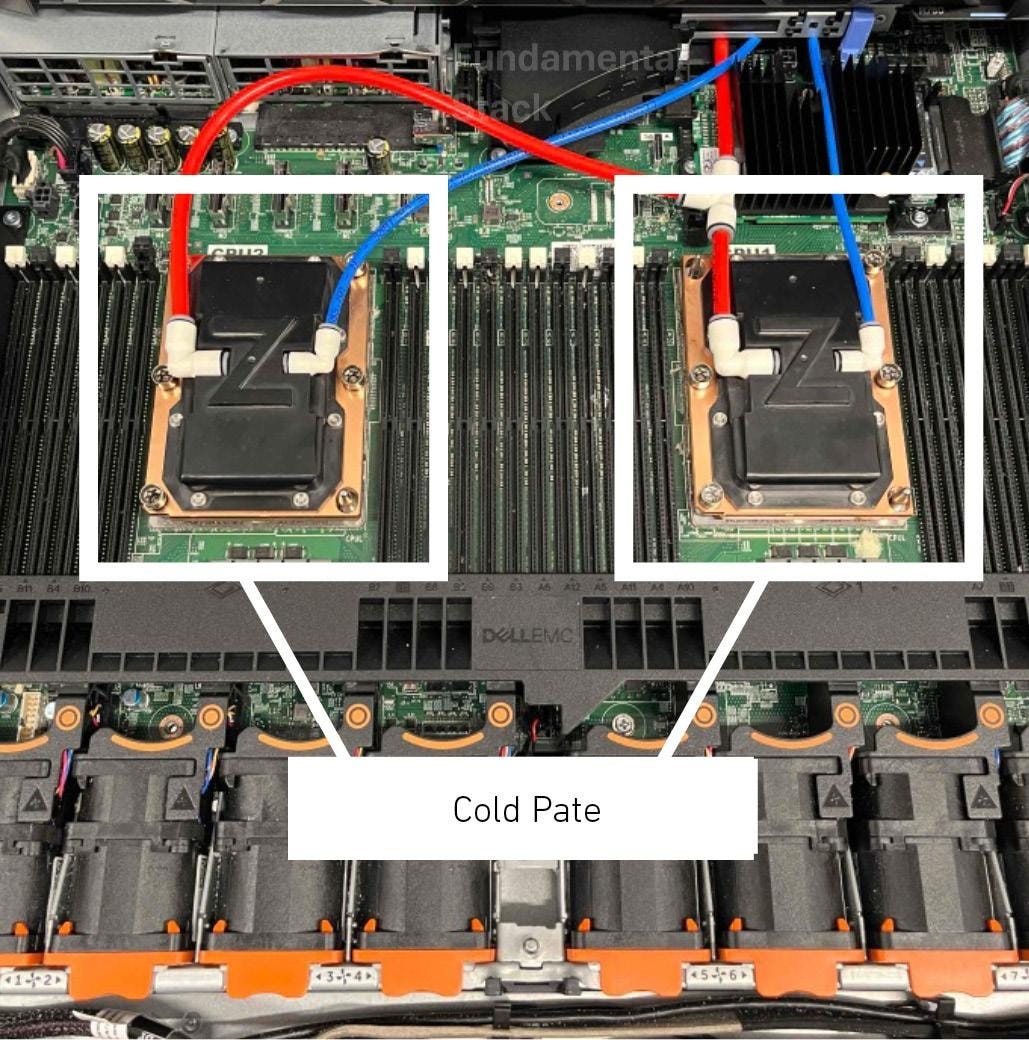
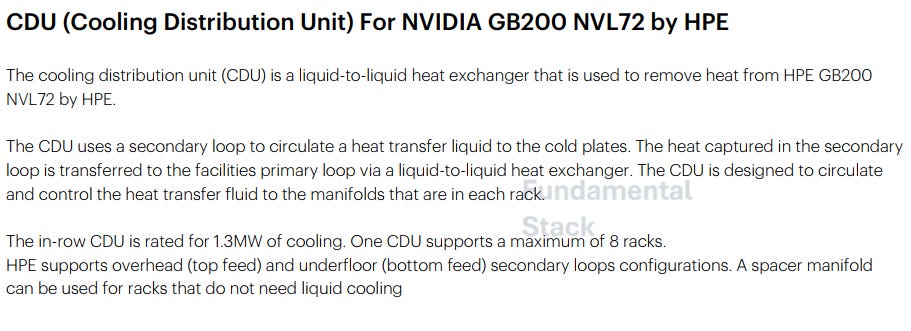
DLC places a cold plate directly on the processor package and routes coolant through a closed loop managed by a coolant distribution unit (CDU). Residual heat from peripheral components like NICs and power supplies remains air-cooled, while the interface between server-level plates and the facility water loop is managed by a Coolant Distribution Unit (CDU). These industrial-scale CDUs maintain separate pressure zones, provide glycol dosing, and utilize redundant pumps to prevent sudden increases in temperature in a possible failure.
In brownfield environments, CDUs introduce a secondary unusual fluid loop that needs to be managed: ultra-pure coolant chemistry, near-zero acceptable leak rate, and pressure control requirements that sit outside the standard HVAC. The CDU could fill 4-10 U’s in the rack version or inrow versions like Vertiv’s XDU1350.
Immersion cooling
Single-phase immersion
Single-phase immersion cooling submerges servers in a dielectric fluid that remains liquid throughout the thermal cycle. Heat is removed via a simplified loop where the warm fluid is circulated through an external exchanger or dry cooler. This architecture eliminates CRAC infrastructure, provides uniform temperature profiles across chips, and supports “free cooling” due to high return temperatures (45-55°C).
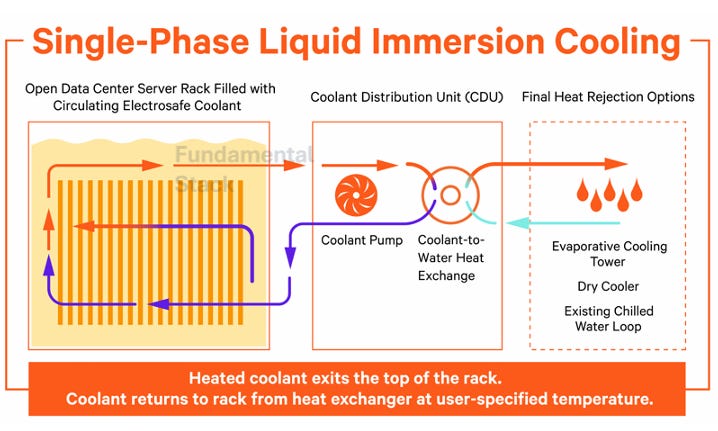
The primary advantages are operational predictability and reduced failure modes compared to two-phase systems. However, the trade-off is a mandatory server redesign; standard hardware is incompatible as oils can dissolve adhesives, wire coatings, and certain plastics. Components must be “stripped” or specially manufactured to prevent outgassing and fluid contamination.
Operational friction points remain a significant barrier to adoption. These include the logistical overhead of maintaining “oil-soaked” hardware, the absence of standardized procurement protocols, and ongoing negotiations regarding OEM warranties. For colocation providers, managing multi-tenant deployments in shared tanks adds a layer of physical and security complexity.
Two-phase immersion
Two-phase immersion leverages latent heat of vaporization to extract more energy per unit of fluid than single-phase.
The principle of two-phase is to directly immerse the motherboard and chips inside the cabinet with a low-boiling-point working fluid. Heat is transferred before the fluid reaches its saturation temperature, and once is reached, the phase change of the working fluid absorbs the heat from the source.
Two-phase could be classified into passive immersion, which relies in the pool boiling mechanism. Active on the other hand, is based on flow boiling mechanism.
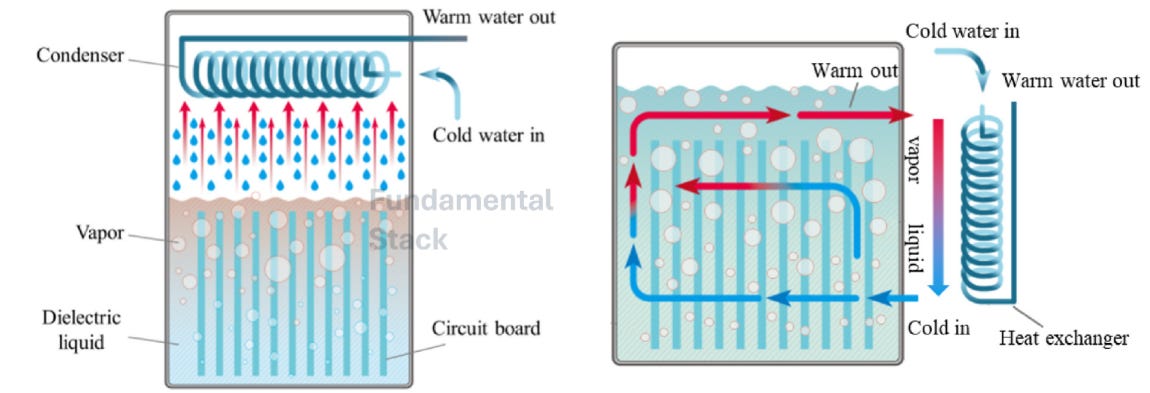
Crucially, the hardware maintains a “brownfield-friendly” form factor, utilizing standard manifolds and quick disconnects that make it indistinguishable from water-based setups. To ensure reliability, the architecture includes a reservoir to eliminate cavitation and uses non-conductive dielectric fluids to negate leak risks.
Two-phase systems submerge servers in a dielectric fluid engineered to boil at low temperatures (typically 40–60°C at atmospheric or slightly elevated pressure). As heat is generated, the fluid vaporizes at the chip surface, a phase-change event that absorbs it with exceptional efficiency through the latent heat of vaporization. The vapor rises to a condenser at the top of the tank, condenses back to liquid, and gravity-feeds back to the bath. Engineered dielectric fluids such as 3M Novec, Chemours Opteon, and Solvay specialty fluids underpin this segment.
Two-phase systems achieve a high heat removal efficiency. A 2024 case study found that two-phase immersion cooling provides lower 10-year TCO than either direct-to-chip single-phase or single-phase immersion cooling at high rack densities, primarily through superior free-cooling hours enabled by higher return water temperatures.
The adoption barrier is the same as single-phase. But also the primary commercial barrier has been proprietary fluid formulations and concerns about fluid evaporation losses, but the transition away from PFAS compounds.
Which liquid cooling technology is “better”?
A study comparing four liquid cooling technologies (immersion, spray, cold plate, and heat pipe) concluded that immersion offers the best balance between cooling performance and energy efficiency. It delivers a high Heat Transfer Coefficient (HTC) and a low Power Usage Effectiveness (PUE), providing superior cooling capacity and economic performance.
However, immersion faces challenges such as potential refrigerant leakage and issues with electrical conductivity.
When classifying cooling by level (room, rack, or chip), chip-level cooling is the most efficient. Because it targets heat at the source, it provides the most effective heat dissipation and maximum energy savings.
The Space Reduction Formula
The floor space efficiency of liquid cooling is often overlooked in financial analysis, yet its impact on capacity is transformative. As rack densities climb, the traditional air-cooling model becomes space-intensive; a 10 kW/rack facility typically devotes 40–50% of its floor area just to cooling infrastructure, such as CRAC units and containment aisles.
Transitioning to liquid cooling changes this math by eliminating bulky overhead units, raised floors, and aisle containment. Operators report significant improvements in IT load per square foot:
- Direct-to-Chip (DTC): 30–50% improvement in density.
- Immersion Cooling: 50–120% improvement in density.
- Retrofits: In existing buildings, replacing perimeter CRAC units with Direct Liquid Cooling (DLC) can reduce the cooling footprint by 50–85%.
This footprint reduction is critical in supply-constrained markets. In Northern Virginia, for example, vacancy rates dropped to 0.9% in 2024 despite rising inventory. In such regions, where land and power are scarce, liquid cooling serves as a “capacity multiplier,” allowing operators to pack more compute into fixed footprints.
This efficiency is particularly valuable for colocation and enterprise sectors in high-density urban areas. For industries like High-Frequency Trading (HFT), where data centers must be physically near exchanges in cities like New Jersey, Chicago, London, or Sydney to minimize latency, liquid cooling enables high-performance clusters within small, expensive urban footprints. By shrinking the space required for infrastructure, operators can maximize high-margin IT space in the world’s most expensive real estate markets.
Adoption Paths outside hyperscalers
The consensus view is that liquid cooling is a hyperscaler phenomenon and enterprise adoption will lag by years. The Uptime Institute 2024 survey confirms this view has merit — the institute’s own research notes that the liquid cooling revolution is “likely to bypass enterprise IT for several years in favor of AI training.” But this framing misses the structural forces now pushing liquid cooling into tier-two operators.
The first force is vendor lock-in by OEMs. NVIDIA H100 SXM5 and B200 in liquid-cooled configurations outperform air-cooled variants by 20% in sustained throughput — meaning enterprises renting or purchasing these systems at rack densities above 30 kW have no choice but to request liquid cooling from their colocation provider or build it into their own facilities.
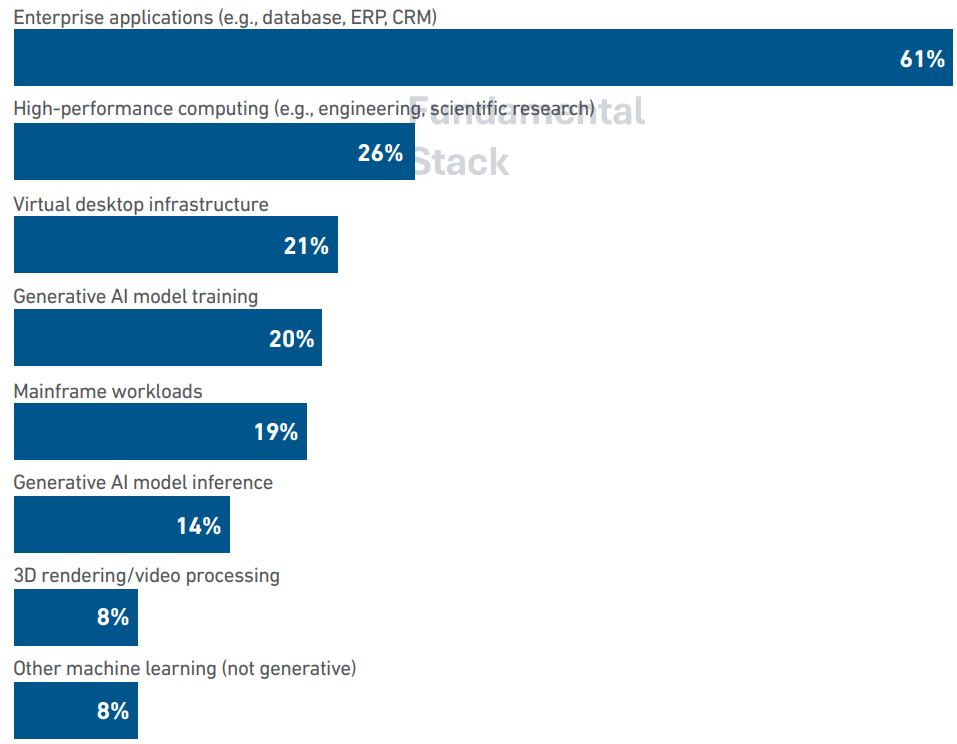
The second force is the colocation infrastructure refresh cycle. Colocation providers building or retrofitting facilities in 2024–2026 are designing for 30–50 kW per rack as a baseline, with liquid cooling capability specified as either standard or an available upgrade path. Equinix, Digital Realty, and Switch have all announced liquid cooling deployment programs. This means even enterprises deploying in third-party colocation are increasingly operating in liquid-cooled infrastructure whether they asked for it or not.
The third force is regulatory pressure on PUE and WUE, particularly in the European Union, where the EU Energy Efficiency Directive mandates PUE targets for large data centers. Liquid cooling’s structural PUE advantage over air cooling makes regulatory compliance materially easier for operators facing these benchmarks.
Not only hyperscalers will adopt liquid cooling but all enterprise and colocation data center that plans use AI in their operations. Since there is demonstrated benefits in liquid cooling in TCO savings will make evaluate.
Signs in the HFT industry
High-frequency trading (HFT) represents a critical vertical within the “New Jersey Triangle”, the NY4, Carteret, and Secaucus hubs where U.S. equity markets are concentrated. While the HFT firms have historically been the most resistant to using water near electronics.
The objective for the HFT industry isn’t neccesarily energy efficiency but instead the elimination of “thermal throttling jitter.” . Because competitive advantages are measured in nanoseconds, the micro-fluctuations in clock speed inherent in air-cooled systems can result in millions of dollars in losses.
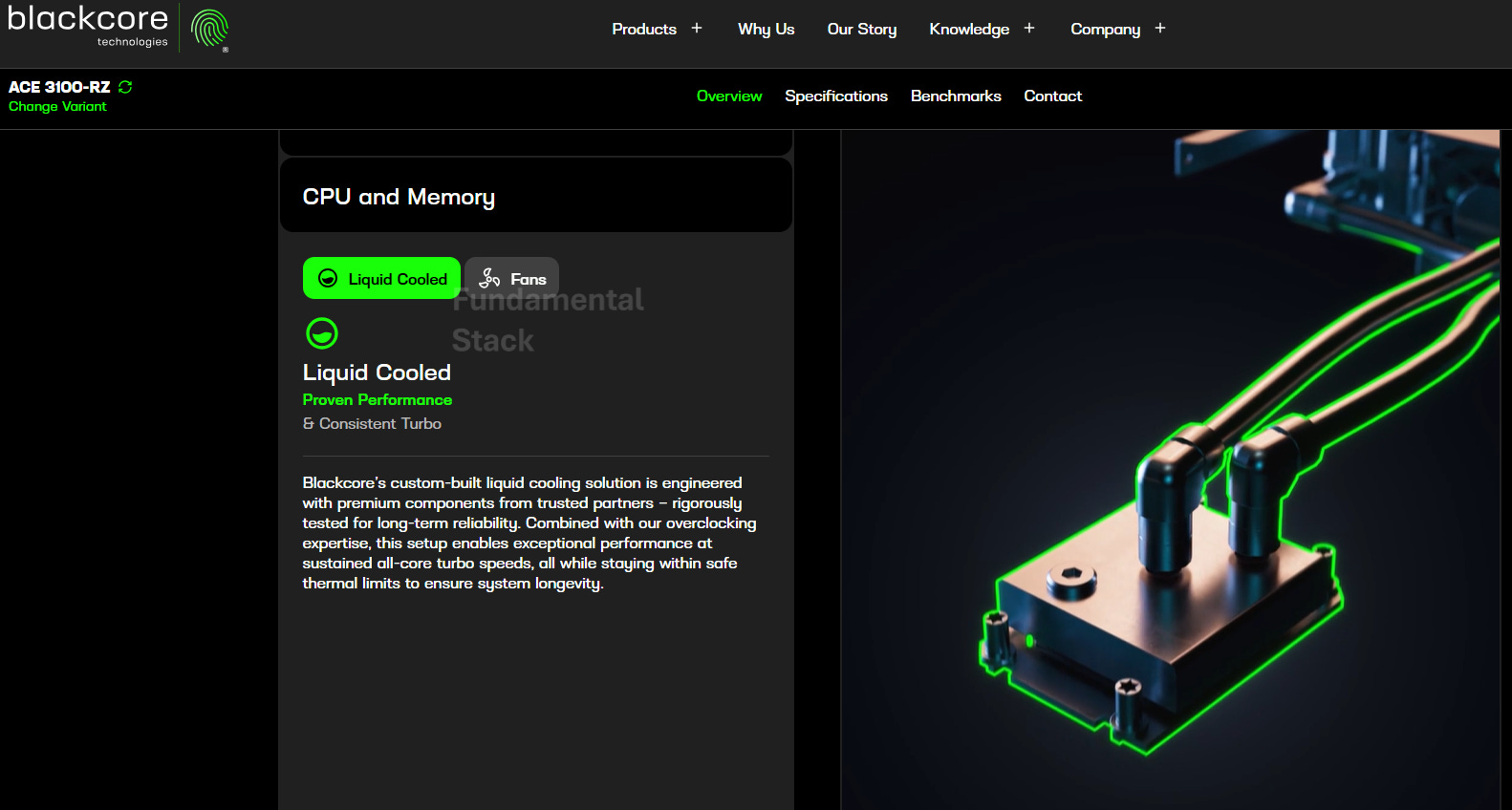
However, firms are shifting to liquid cooling, companies like Blackcore Technologies which specializes in servers optimized for HFT. They have the ACE ACE 3100-TS+ a 2U server up to 32 Cores . This density and required frequency stability is physically impossible in a 2U chassis without liquid cooling.
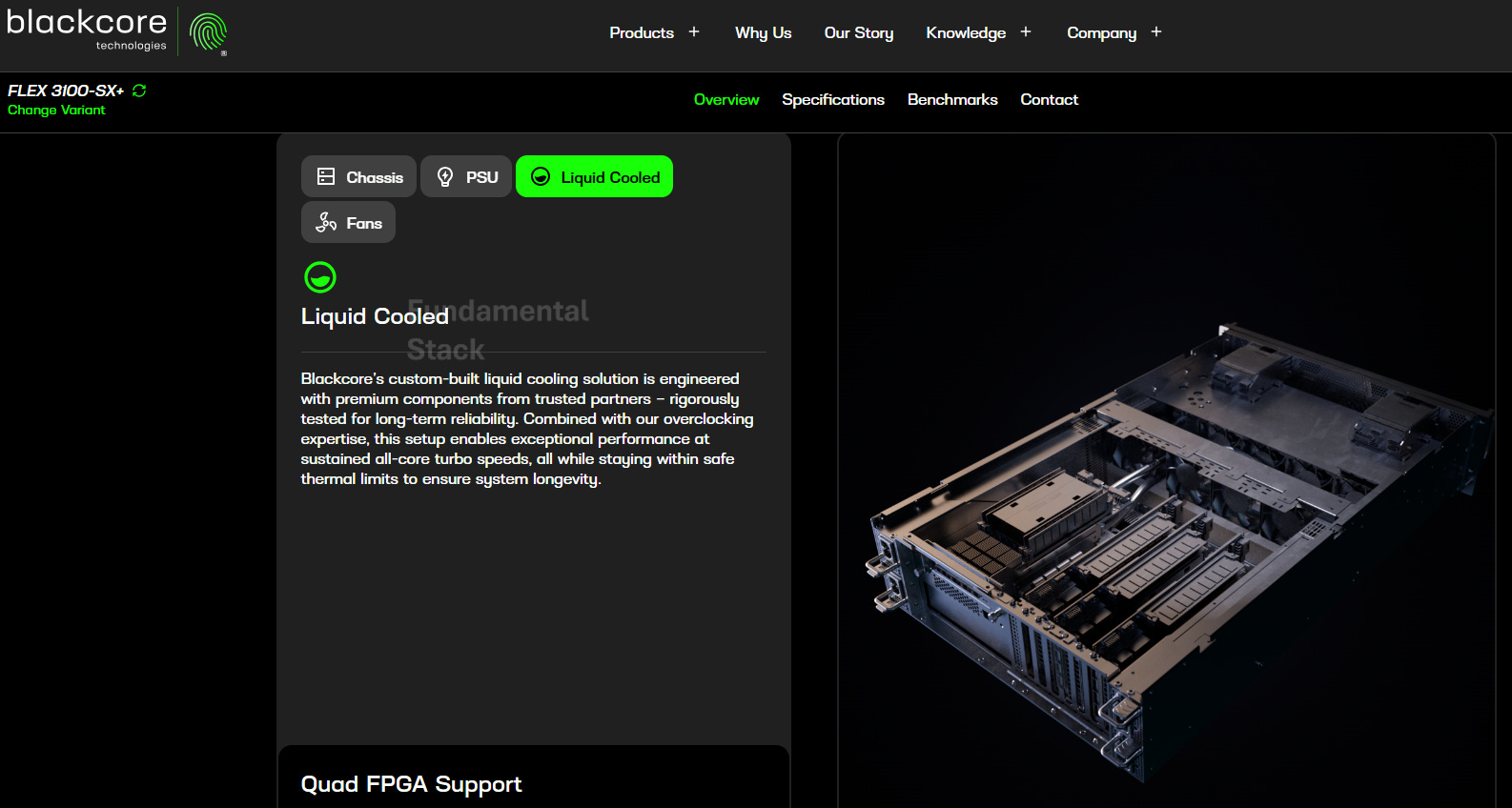
The company still keeps the air cooled solutions simultaneously with liquid cooling, using forinstance the FLEX 3100-SX+ a 3U hybrid-cooled server with a CPU (the Intel Xeon-W 3595X) is liquid-cooled and has a third bank of fans specifically for the FPGAs. It’s essentially “brute-forcing” air through the dense fins of the FPGA heatsinks.
III. The Supply Chain: Critical Components (Picks & Shovels)
The CDU: Thermal Nervous System
The Coolant Distribution Unit (CDU) is the essential hub of the liquid cooling system, acting as the interface between the building’s water supply and the server’s cooling plates. It ensures the system runs reliably by managing fluid temperature, pressure, and chemistry. To protect sensitive equipment, CDUs feature redundant pumps, fine filtration to prevent clogs, and built-in leak detection.
The market for CDUs is expanding rapidly, growing from $1 billion in 2024 to a projected $3.6 billion by 2031.
CoolIT Systems is one of the top producers of CDU’s the company produces industrial-scale units like the CHx2000, capable of cooling 2 MW. As of march 2026, Ecolab Inc. ECL -0.78%↓ announced a definitive agreement to acquire CoolIT Systems from private equity firm KKR for approximately $4.75 billion.
Quick Disconnects
Every cold plate in every server in every liquid-cooled rack requires a fluid connection that can be made and broken safely, repeatedly, and without spillage by technicians who are not specialized plumbers. The Universal Quick Disconnect (UQD), a standard developed through the Open Compute Project is a critical fastener of the liquid cooling supply chain, and its market that barely existed five years ago.
Danfoss Power Solutions has become the leading supplier in this space with its Hansen UQD family. The Danfoss UQD offers 25% higher flow rate than OCP baseline specifications, a flat-face dry-break design that prevents spillage even if misassembled, 100% helium leak testing at the factory, stainless steel body with EPDM seals for broad fluid compatibility, and a one-hand push-to-connect mechanism that enables tool-free hot-swap maintenance.
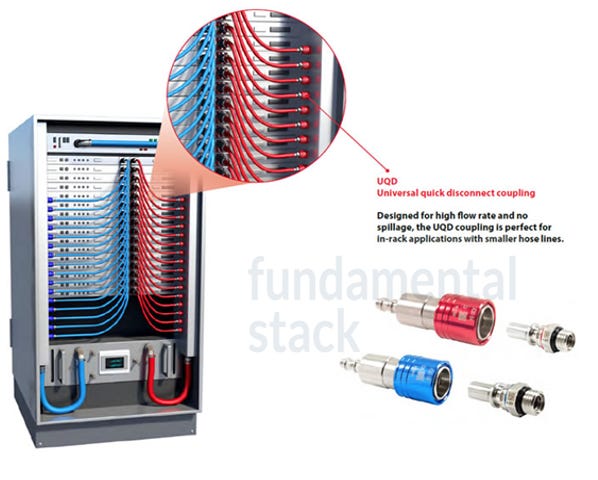
The global UQD coupling market is projected to growt at 46.1% CAGR to 2031. Key competitors alongside Danfoss include Parker Hannifin, Staubli, and JONHON. The OCP standardization of the UQD format reduces vendor lock-in risk and is accelerating adoption by enabling interchangeable components from multiple suppliers.
Dielectric Fluids: between regulation and innovation
As liquid cooling adoption progresses, the choice of coolant has become a critical strategic decision. The fluids used are not universal; they vary significantly depending on the cooling architecture.
Currently, three primary technologies dominate the market, each requiring a different chemical approach:
- Direct-to-Chip (DTC) / Cold Plate: Uses Water-Glycol mixtures. The fluid is treated with inhibitors to prevent corrosion and stays strictly within a closed loop.
- Single-Phase Immersion: the fluid use are synthetic hydrocarbons or silicone-based fluids. These remain liquid and are chosen for their long-term material compatibility.
- Two-Phase Immersion: uses fluorinated dielectrics or PFAS (like Novec-649). These fluids boil at low temperatures to carry heat away as vapor, utilizing latent heat for maximum efficiency.
The industry is currently facing scrutinity due to PFAS, often called “forever chemicals” because they do not break down.
- In Europe: The F-Gas Regulation and REACH are moving toward strict bans on high-impact fluorocarbons.
- In the US: The EPA’s AIM Act is phasing down HFCs by 85% by 2036, while several states are implementing their own PFAS reporting mandates.
Nanofluids: Chemistry as Performance
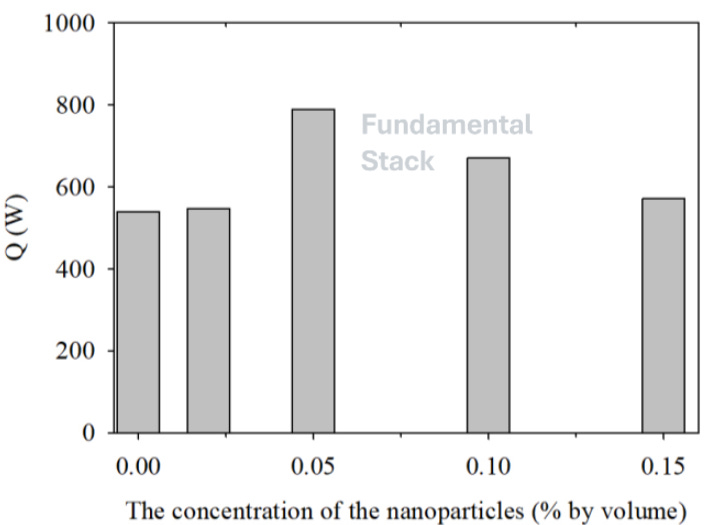
Nanofluids offer a promising path toward economic viability by significantly boosting cooling performance. While standard water-based direct-to-chip cooling provides a solid baseline, adding TiO2 nanofluids at a precise 0.05% concentration can increase the heat transfer rate from ~530W to ~790W—a 50% efficiency gain without changing the physical hardware.
However, this chemistry-driven approach has limitations. Unlike the dielectric fluids required for immersion cooling, nanofluids containing oxide particles possess some electrical conductivity. They also present operational challenges, such as particle deposition and potential corrosion over time. Despite these hurdles, the performance jump demonstrates that the future of high-density AI cooling lies as much in fluid chemistry as in mechanical engineering.
Heat rejection systems as the Long Incumbent
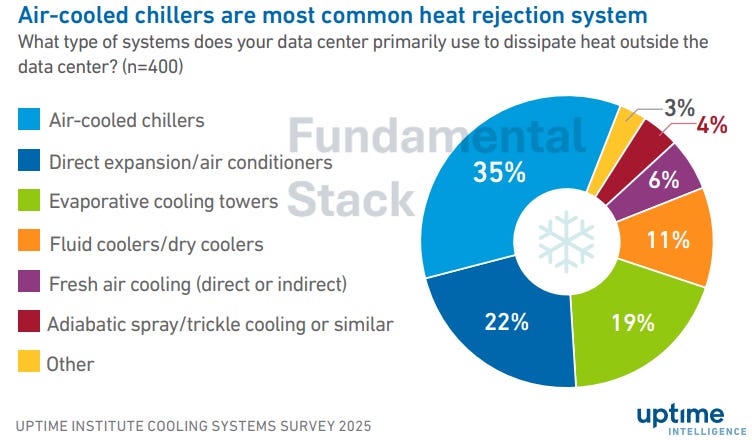
As liquid cooling adoption progresses, the facility-level heat rejection system, the equipment that moves heat from the building to the outdoors, operates under a distinct competitive dynamic. Products like air-cooled chillers and dry coolers and cooling towers are not disrupted by the move to liquid cooling; they are, in fact, primary beneficiaries of it.
According to the latest 2025 Uptime Institute survey, fluid and dry coolers account for 11% of heat dissipation systems in the market. While this remains a niche segment compared to mechanical chillers, its steady presence indicates a clear preference among operators who prioritize water conservation and simplified maintenance.
Lu-Ve Spa is the market leader in this sector. Their oval-tube technology is 15% more efficient than standard round tubes and requires 40% less fan power. LUVE’s hybrid systems can also switch between dry and evaporative modes, providing critical flexibility for operators in water-stressed regions.
The investment case for these systems is straightforward: the equipment is technology-agnostic. Because these units sit at the end of the thermal chain, they can be adapted to any liquid cooling architecture. Whether a data center utilizes cold plates, immersion, or two-phase systems in the secondary loop, the primary facility loop still requires these outdoor units to reject the final heat load to the atmosphere.
However, one thing is clear: most greenfield data center projects prioritize water conservation and simplified maintenance in order to avoid regulatory hurdles and potential conflicts with local communities over water resources. Dry cooler technologies fulfill these needs.
Regardless of which liquid cooling method wins, the total volume of fluid requiring outdoor heat rejection is increasing. Other company with dry cooler solutions in their portfolio os Modine .
IV. Competitive Landscape and Market Analysis
Vertiv
Vertiv is the highest-conviction public equity the liquid cooling transition. With $8 billion in total 2024 revenue, approximately 35–40% attributable to thermal management, Vertiv has relationships with every hyperscaler and the manufacturing scale to meet hyperscale procurement timelines. Vertiv expanded CDU manufacturing capacity 45x in 2024 to address GB200 NVL72 deployment demand. The company acquired CoolTera for advanced high-density liquid cooling IP and acquired assets from BiXin Energy Technology to expand Chinese liquid cooling capabilities.
Vertiv’s rack-to-facility vertical integration, its specification relationships with OEMs including NVIDIA and Intel, and its global service network create switching costs that smaller competitors cannot easily replicate. However, current valuation levels are making a bet on sustained cadence of AI infrastructure capex that outlasts any cyclical correction.
Schneider Electric
Schneider Electric has aggressively pivoted into the liquid cooling space to defend its market share in data center infrastructure. Their incursion is characterized by moving beyond standalone components to provide fully integrated thermal chains. While their deployment pace is accelerating, Schneider currently faces supply chain bottlenecks particularly in high-precision CDU (Coolant Distribution Unit) components and specialized manifold fittings, as they scale up manufacturing to meet the sudden surge in AI-driven demand.
Financially, Schneider positions its liquid cooling segment as a premium, high-margin offering. While nVent commands high margins on high-volume components and Vertiv leads in massive hyperscale contract pricing, Schneider maintains an edge by bundling cooling with their industry-leading power and software suites. Their star product is the Coolant Distribution Unit (CDU), specifically their modular floor-mount units, which act as the “brain” of the secondary loop, managing fluid pressure and heat exchange with the precision required for GPU clusters.
nVent Electric
nVent occupies a structurally different position from Vertiv — focused on the “gray space” infrastructure of data centers (enclosures, thermal management of non-compute equipment, grounding, and power distribution) rather than the white-space IT cooling equipment itself. Through its Hoffman and Schroff brands, nVent manufactures enclosures with integrated liquid flow-through cooling modules for edge and telecom deployments. Its liquid cooling product line has been deployed in over 1 GW of data center capacity since 2020.
The strategic significance of nVent’s 2025 acquisition of Avail Infrastructure Solutions’ Electrical Products Group (EPG) gives nVent end-to-end data center infrastructure capability by integrating liquid cooling with power distribution, enabling a combined thermal-and-power systems value proposition similar to players like Vertiv. Q3 2025 organic orders rose approximately 65% year-over-year, with management attributing most of the increase to large liquid cooling.
The pivoting companies
Modine Manufacturing
Modine Manufacturing MOD -3.38%↓ represents the most aggressive transformation in the thermal supply chain, pivoting from legacy HVAC and vehicular manufacturing to become a high-growth data center powerhouse. Data center revenue jumped from $294M in FY24 to $644M in FY25, a 119% year-over-year increase. With management targeting over $2B by fiscal 2028, Modine is focusing on being a thermal management specialist where the data center segment now drives roughly a quarter of total revenue.
The company’s strategy has been a mix of organic engineering and IP acquisitions, notably the TMGcore acquisition which added immersion cooling to their portfolio. Modine’s data center segment delivers 18.3% EBITDA margins, yet the stock often trades at nearly half the multiple of Vertiv.
Lennox International
Lennox LII -0.17%↓ occupies a complex position in the market. While it is a leader in residential and commercial HVAC, the company is now pivoting toward data center markets.
However, Lennox faces a challenge that comes from differentiation . Unlike “infrastructure-native” competitors like Vertiv, nVent, or Modine, Lennox lacks established intellectual property in precision cooling and liquid cooling.
The data center cooling sector deeply rewards specialized engineering depth and long-standing certification relationships with OEMs. Because Lennox is building these capabilities from a lower base than its competitors, its success depends on how quickly it can close the technical gap in high-density cooling solutions.
New entrants
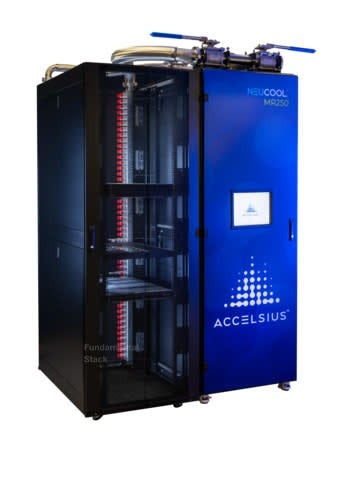
Accelsius is the most technically disruptive new entrant in the liquid cooling market, moving beyond standard water-glycol systems with its NeuCool platform. NeuCool uses a two-phase, direct-to-chip approach where a dielectric refrigerant boils directly on the chip surface. This “flow boiling” leverages the latent heat of vaporization, allowing for massive heat removal with significantly lower flow rates and the ability to handle the violent power spikes typical of AI workloads.
The economic implications are substantial. By allowing facility water temperatures to be up to 8°C higher than single-phase systems, Accelsius drastically increases “free-cooling” hours and reduces chiller dependence. With the capacity to cool 250 kW per rack and 4.5 kW per GPU socket, Accelsius is explicitly positioned for the upcoming NVIDIA GB300 generation and beyond.
Other new entrants worth tracking include ZutaCore, an Israeli company commercializing waterless two-phase DTC cooling through its HyperCool platform; LiquidStack, which raised $50 million Series C in 2024 to scale hyperscale immersion deployments; and Chilldyne, acquired by Daikin Applied in November 2025 for strategic expansion into data center DTC cooling.
V. Risks, Friction, and the Bear Case
Labor Friction: The Certified Technician Shortage
The greatest risk to liquid cooling adoption is a potential labor shortage. Transitioning to liquid systems requires specialized skills that the current IT workforce lacks and the HVAC industry is struggling to supply.
The people gap
Maintenance for two-phase systems requires regulated refrigerants requires EPA Section 608 Universal certification. This creates a bottleneck:
- The US HVAC industry faces a deficit of roughly 110,000 technicians.
- The average technician is 55 years old. For every five professionals who retire, only two new workers enter the field.
- While the general workforce grows nominally, the number of highly skilled, certified technicians remains flat while demand explodes.
The Skill Mismatch
Traditional data center staff are experts in IT infrastructure, not “wet-side” mechanical systems. Liquid cooling demands a specific hybrid skill set:
- Closed-loop fluid management and industrial plumbing.
- Refrigerant handling and leak containment protocols.
- CDU commissioning and load-matched flow management.
Without a massive investment in trade schools and apprenticeship programs, the transition to AI-ready data centers will be bottlenecked by a lack of licensed human experts, not the cooling hardware itself.
Standardization: The Industry weak spot
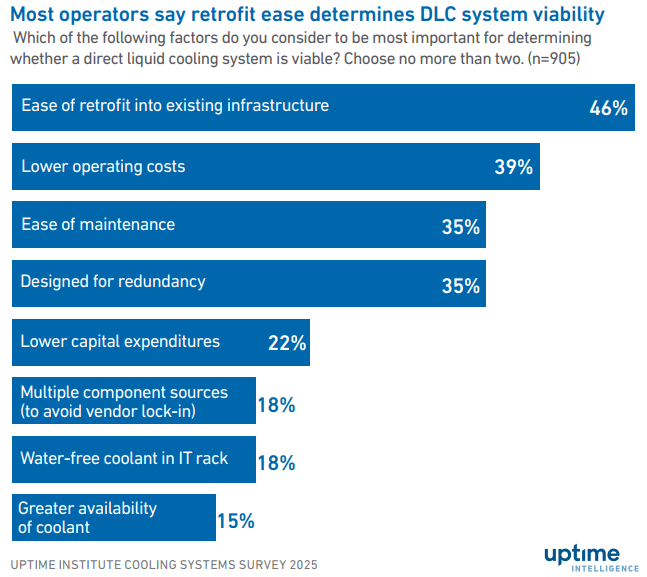
The lack of general standardization is currently the single largest barrier to liquid cooling adoption. According to the Uptime Institute Cooling Systems Survey 2025, 39% of operators cite this as their top obstacle.
The Standardization Gap
The industry is currently fragmented across multiple layers:
- Proprietary Designs: Cold plates are often vendor-specific and not interoperable between server generations.
- Inconsistent Chemistry: Every manufacturer has different requirements for coolant pH, glycol percentages, and inhibitors.
- Interface Friction: Connection types and leak-detection protocols vary wildly between CDU manufacturers.
Is OCP Enough?
The Open Compute Project (OCP) has made progress with standards like the Universal Quick Disconnect (UQD) to create a common physical coupling. However, this is not enough. While the hardware can physically “plug in,” the broader system-level interoperability—such as software communication between the server and the CDU, or fluid chemistry compatibility—remains unresolved.
Certification Status
Certification bodies are in a “catch-up” phase, creating a period of regulatory ambiguity. And despite certify facilities are based on performance outcomes rather than specific hardware, they evaluate results. If a liquid-cooled design can prove it has redundant paths, no single points of failure, and can withstand a leak or pump failure without dropping the IT load, it can earn a tier rating
- Uptime Institute: While their Tier Standard remains the global benchmark, it has not yet been fully updated to include specific “resilience requirements” for liquid cooling. This leaves operators uncertain about how to maintain Tier III or IV ratings in a liquid-cooled environment.
- ICREA: Like Uptime, ICREA is beginning to incorporate liquid cooling into its standards, but formal certification pathways specifically for “liquid-ready” facilities are still maturing.
- ASHRAE TC 9.9: Their 2024 technical bulletins provided a major step forward in codifying best practices for liquid cooling resilience. However, these are guidelines, not mandatory standards.
Insurance: The Silent Cost Premium
The insurance industry has not yet fully priced the risks of liquid cooling, and the current rates are often unfavorable. Many insurers initially charged 15–20% higher premiums for liquid-cooled facilities compared to air-cooled ones. This is largely due to fears of “catastrophic water intrusion”—a scenario where a cooling unit or pipe failure floods a data hall, leading to massive hardware replacement costs and long periods of downtime.
Underwriters specifically worry about:
- Leakage: Immersion fluids like mineral oil are sometimes classified as combustible, requiring strict fire codes.
- Fire Suppression: Existing gas-based fire systems are designed for open air and may not be effective in spaces filled with immersion tanks and vapor.
- Lack of data: Because large-scale liquid cooling is relatively new, insurers don’t have enough historical data to feel “safe” with their pricing.
In some regions, this leads to a “regulatory headache.” Immersion tanks might be classified as “flammable liquid storage” instead of IT equipment, which can delay permits by months and increase costs.
However, the narrative is starting to change. Progressive insurers are beginning to offer 5–10% discounts to operators who can prove their systems are safer. Data shows that liquid-cooled sites actually experience 60% fewer cooling-related outages and 40% less damage from overheating.
For the next 3 to 5 years, insurance will likely remain a “hidden cost” in the total budget. To get better rates, operators must invest in high-end leak detection, containment pans, and emergency shut-off valves. Underwriters are waiting for the engineering reality to prove itself over time before they truly lower the price of entry.
New potential disruptions
The direct-to-chip cold plate is facing competitive pressure from new generation approaches.
Silicon-embedded microchannel technology works directly on the chip. It builds fluid channels directly into the chip package substrate, eliminating the thermal interface material (TIM) stack entirely and creating a cooling path with junction-to-liquid thermal resistance approaching 0.01 K/W. NVIDIA and HP are collaborating on a Silicon Microchannel Cold Plate (SiCP) that uses HP’s fifth-generation MEMS microfluidic technology to target heat removal of over 1 kW at a pressure drop below 60 kPa. Academic research (published at IEEE ITherm 2024) demonstrates that staggered-post microchannel geometries achieve heat fluxes approaching 1,000 W/cm² in laboratory conditions, compared to roughly 300 W/cm² for today’s best commercial cold plates. Commercialization risks include mechanical stress at chip level and channel clogging.
Silicon-Integrated Micro Cooler (IMC-Si), is the most significant upstream player in embedded cooling, meaning the future GPU’s TSMC packages will likely include standardized coolant ports as part of the advanced packaging stack. When that design convention is established, the entire liquid cooling ecosystem faces disruption.
LHP – Long Heat Pipe. This technology could disrupt the market by offering a simpler, more reliable alternative to traditional “direct-to-chip” water cooling. Unlike standard heat pipes, which struggle to move heat over long distances, Loop Heat Pipes use a “split” design that separates rising steam from returning liquid. This allows them to carry considerable heat loads over 1.5 kW.
Because the system is entirely passive, it doesn’t need mechanical pumps, meaning there is no vibration, no extra power consumption, and no risk of pump failure. More than just a replacement for existing liquid cooling, these heat pipes allow to move heat away from the server and directly to the rack’s edge. This reduces the heavy lifting required by data center air conditioning (CRAC/CRAH) and lowers the total energy load on the entire facility.
VI. Conclusion: The adoption thesis
Our framework identifies four tiers of opportunity.
The first tier, hyperscale CDU and DTC cold plate manufacturers Vertiv VRT -3.40%↓ , CoolIT Systems through main company, Ecolab ECL -0.78%↓ .
The second tier: picks-and-shovels infrastructure components Danfoss UQD and Parker Hannifin PH -0.05%↓ . Heat rejection systems that will benefit from densitites increse: dry coolers company LuVe Spa ($LUVE.MI) , Modine MOD -3.38%↓and
The third tier: HVAC company pivots Modine MOD -3.38%↓ and Lennox LII -0.17%↓ which requires previous execution validation.
The fourth tier is for liquid cooling insurgents and potetntial disruptors like Accelsius or their parent company INV -0.76%↓ with teir two-phase liquid cooling and integrated micro cooler technology IMC-Si that comes from Taiwan Semiconductor TSM -2.02%↓ that could disrupt the liquid cooling at going at chip level.
A bonus tier are insurance and reinsurance companies, that will benefit from the lack of standarization practices and potential increase in risk of liquid cooling technologies which will increase insurance premiums. Companies like Chubb CB -1.32%↓ American International Group AIG -0.41%↓ and Allianz SE.
On the short side, companies with heavy revenue concentration in traditional air-cooled CRAC/CRAH units and limited liquid cooling portfolios. Companies like Stulz and Munters.
Another short is technical floor. Companies like Mohawk MHK 0.61%↑ and Kingspan Group $KGSPY among the potential long-term losers.
The labor friction and standardization gaps are real headwinds but are not structural blockers — they are solvable problems with time and investment. The regulatory tailwinds from PUE mandates and PFAS phase-downs are accelerants, not risks.
The data center cooling market has spent 30 years optimizing air. It will spend the next 10 years optimizing liquid. The infrastructure transition is underway. The only question is whether investors are early, on time, or late.